This article is for the customers I work with. It sums up where Copilot Managed Runtime stands with the EU Data Boundary in November, after a discussion about whether to stay on Code Apps or plan a migration to Copilot Managed Runtime. Microsoft announced on November 5 that Claude models in Microsoft Copilot will be processed inside the EU Data Boundary by the end of 2026.
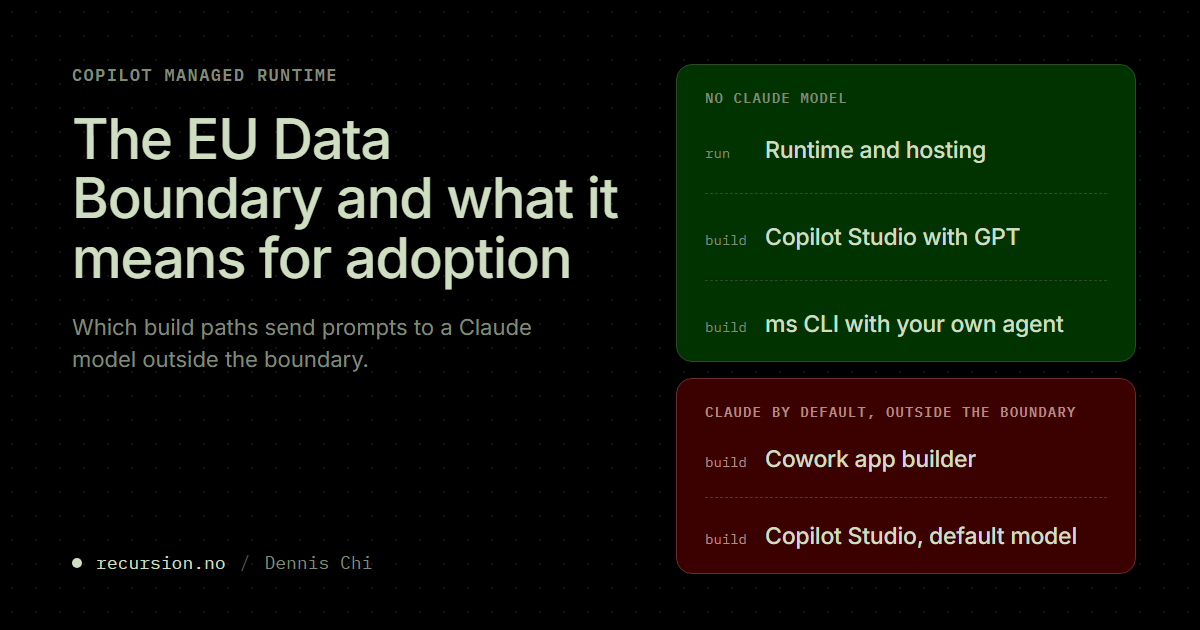
Some European companies wanted to test the Copilot Managed Runtime preview (also called Managed Apps) and held back because a Claude model outside the boundary could receive prompts, code and company data during the build.
Microsoft says the change applies to Copilot Cowork. Microsoft does not say whether it applies to Copilot Studio.
What Microsoft announced
Charles Lamanna wrote on the Microsoft Copilot blog that organizations in the EU and the European Free Trade Association (EFTA) will be able to use Claude models “across Copilot experiences, including Copilot Cowork, with processing within the EU Data Boundary”. Microsoft has promised more details closer to availability.
An organization that already has Claude enabled does not need to do anything, because processing moves into the boundary automatically once it is available.
The setting stays disabled by default in the EU and EFTA. An admin can enable it for all users / selected users and groups under Microsoft 365 admin center > Copilot > Settings > View all > AI providers operating as Microsoft subprocessors.
Today
The Microsoft documentation still said on November 9 that Claude models are “currently excluded from the EU Data Boundary”. When an admin allows Claude, the EU Data Boundary documentation says “Customer Data is processed by Anthropic in the United States”. The data continues to be stored inside the boundary.
The setting Copilot in Microsoft 365 apps with Anthropic models is on by default for EU, EFTA and UK tenants created after March 25, 2026. Copilot in Word, Excel and PowerPoint then processes data outside the boundary when it uses a Claude model. An admin of an older tenant finds the value in Message Center.
Preview features
Microsoft’s EU Data Boundary commitment does not cover services in preview. In my experience, preview features have often only been available from US data centers, and Microsoft usually announces those limits with the feature. Copilot Managed Runtime is in public preview, so a company with a hard EU requirement should check the limits listed for each feature before it starts.
Build paths specifics
Copilot Studio
Microsoft has not said the change applies to Copilot Studio, and Learn’s model table for Copilot Studio agents still marks every Claude model as cross-geo for Europe. A maker who has to stay inside the boundary can use GPT-6 Astra, the only model without that label after November 30.
Copilot Cowork
Microsoft says the change applies to Copilot Cowork, so a company can plan against the date. Learn still says only GPT models are supported for organizations within the EU Data Boundary, so a company can pilot Cowork on GPT models until then.
Copilot Code
Copilot Code is a Copilot experience, so the promise should cover it. Copilot Code requires Frontier, so an admin can keep people who handle restricted data out.
Copilot Managed Runtime CLI
Microsoft supplies no model on this path, so the announcement changes nothing here. A developer who drives the ms CLI with a coding agent sends prompts and code to that agent’s provider, which is the same exposure as with Code Apps today. GitHub Copilot on GitHub Enterprise Cloud with EU data residency has a policy that keeps inference in the region. No Learn page says the Copilot Managed Runtime host itself is an EU Data Boundary service, so that is still a question for Microsoft.
Adoption
EU companies that held back only because of Claude can plan against the end of 2026 for Copilot Cowork. Copilot Studio Managed Apps in preview has no date yet.
My hunch is that Copilot Studio managed apps will be added by the same date. In the meantime, I advise using the Code Apps CLI with your own coding agent that respects the boundary, until your organization needs a migration to democratize app-building. A team that wants to start on Copilot Managed Runtime now can use the Copilot Managed Runtime CLI the same way. That raises another question for another time: does your organization need it, and is your team mature enough to support it?
An EU company that accepts processing in the United States can opt in to Claude for now.
Before a European company takes a service like this into use, it often documents where personal data is processed in a data protection impact assessment (DPIA). If that assessment says Claude processes data in the United States, it is out of date once Claude moves inside the boundary. A tenant that already turned on Claude moves automatically, so nobody gets a reminder to update it. I would set a review date in the assessment now.
Has your organization planned for this yet? If you want to discuss my thoughts and strategy for adopting these new features safely, drop a comment below or find me on LinkedIn.
Leave a Reply