
What changed with Claude Fable 5 compared to Opus? A new tier above the older model at twice the price, and safety that now lives in the API itself. Anthropic shipped it on June 9, 2026, alongside a sibling model, Claude Mythos 5.
What Claude Fable 5 and Claude Mythos 5 are
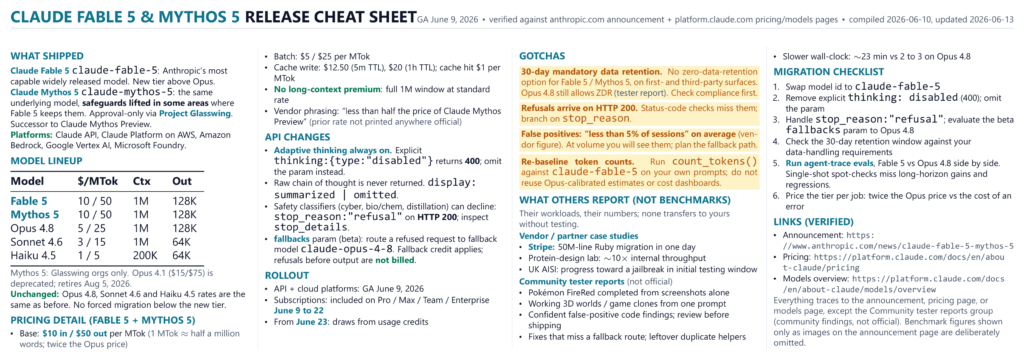
Claude Fable 5 (claude-fable-5) is Anthropic’s most capable widely released model. It went GA on June 9, 2026 on the Claude API, Claude Platform on AWS, Amazon Bedrock, Google Vertex AI, and Microsoft Foundry. It carries a 1M token context window and 128K max output tokens.
Claude Mythos 5 (claude-mythos-5) is the same underlying model, but with its safeguards lifted in some areas where Fable 5 keeps them. It succeeds Claude Mythos Preview and is approval-only, through Project Glasswing.
Anthropic’s launch leans on customer stories rather than benchmarks: Stripe reports a 50-million-line Ruby migration in a day, one demo plays Pokémon FireRed from screenshots alone, and a protein-design lab cites roughly 10× throughput. Each of these happened on one team’s specific setup, so take them as a reason to try Fable 5 on your own work, not proof it will do the same for you.
What stayed the same
Before you change to the new model, look at what’s still the same in between both. Claude Fable 5 matches Opus 4.8 on the basics:
- Same request surface: adaptive thinking, no sampling parameters, no prefills
- Same limits: 1M context, 128K output
- Same prices across the rest of the lineup (table below)
Nothing here pushes you up to the new tier. If your current model does the job, you can stay on it.
How Claude Fable 5 compares on price and limits
First, the price in terms how it affect your digital wallet. A million tokens is roughly half a million words. Input is what Fable 5 reads; output is what it writes back.
Say you hand it a mid-size codebase, around 50,000 words, and ask for a few pages of review back. That is a dollar or two on Fable 5, about half that on Opus 4.8. Small per run; it is the volume across a working week where twice the rate shows up.
Fable 5 and Mythos 5 both list at $10/$50 per MTok, which Anthropic calls “less than half the price of Claude Mythos Preview”. The rest of the rates:
- Batch: $5/$25 per MTok
- Cache writes: $12.50 (5-minute TTL) or $20 (1-hour TTL); cache hits $1
- No premium on the full 1M context window
On subscriptions, Fable 5 is included on Pro, Max, Team, and Enterprise from June 9 to 22. After that you pay for it separately, on top of the plan. Two things testers flag: while it is included, Fable 5 uses up your plan’s allowance about twice as fast as Opus 4.8, and Anthropic has not formally revealed how the paid-credit pool will work. If you need predictable billing, the API rate above is the safer number to plan around.
| Model | Input / Output per MTok | Context | Max output | Thinking |
|---|---|---|---|---|
| Claude Fable 5 | $10 / $50 | 1M | 128K | Adaptive, always on |
| Claude Opus 4.8 | $5 / $25 | 1M | 128K | Adaptive |
| Claude Sonnet 4.6 | $3 / $15 | 1M | 64K | Adaptive |
| Claude Haiku 4.5 | $1 / $5 | 200K | 64K | Extended |
Three features summarized
The facts above come from the announcement and the pricing and models pages. The three features below are my analysis, based on what I’ve read and understood from the sources.
1. A new most-capable model, at a new price
It helps to know how the lineup works. Claude has come in three levels: Haiku for cheap and fast, Sonnet in the middle, and Opus for the hardest work. Fable 5 now sits above Opus as the most capable, at twice the price. So picking a model is a budget decision now: Opus 4.8 for most hard work, Fable 5 when getting a long job right is worth paying twice for. The question on each job is what a mistake would cost you.
2. Safety now lives in your code, not a policy
Refusals used to live in a usage policy you agreed to once. Now the model can decline mid-request, so you handle it the way you already handle a failed API call or a timeout: detect it, decide on a fallback, move on. The full mechanics are below. Safety stopped being a page you read and became a path you build.
3. The real test is how long it runs on its own
Look at what the demos actually did. Stripe ran a migration that would take a team days and finished it in one. One test played Pokémon FireRed start to finish from screenshots alone, with no help. The common thread is not a higher score on a quick test; it is the model working on its own for a long stretch and reaching the end. That is the thing worth testing: not whether it is sharp in one answer, but whether it holds together over a long job you are not watching.
What early testers report about Fable 5
The sections above rest on Anthropic’s own pages. Since launch, tester reports from the community have started to fill in the picture. These are individual reports rather than benchmarks, so read them as direction, not data. Three threads keep recurring.
The autonomy claims mostly hold up. Testers report one-shot builds of working 3D worlds and game clones, web apps rebuilt from screenshots alone, and Pokémon FireRed completed from raw frames without navigation scaffolding. Fiction writers report that it tracks very large rule sets without losing the thread, although the prose still needs editing.
The failure modes look familiar. Code-review tests surface false positives: one tester received a privilege-escalation finding that turned out to be intended behaviour, because Fable had overlooked the access-control code. Others report a fix applied in one file while the same flaw survived in a fallback route, a missed case-sensitivity check on reserved URL paths, and refactors that add a new shared helper but leave the old duplicates in place. The model also stays confident while wrong. So human review of its findings remains mandatory, not optional.
The classifiers fire on legitimate work. Several testers hit refusals on security-adjacent coding tasks and watched the request fall back to Opus 4.8. That matches Anthropic’s own “less than 5% of sessions” figure: small as a percentage, frequent at volume. Speed is the other recurring cost. In one head-to-head, a coding task that Opus 4.8 finished in 2 to 3 minutes took Fable 5 a reported 23 minutes.
None of this overturns the release story. Instead, it sharpens it: the gains show up on long, hard tasks, and the tax shows up as review effort, refusal handling, and wall-clock time.
If you build on the API
A move to Claude Fable 5 is a small code change and a larger evaluation change. The code part: swap the model ID, omit any explicit thinking setting (a disable returns a 400), and branch on the new stop_reason: "refusal", which arrives on an HTTP 200. The evaluation part is the real work: replay full agent traces against Fable 5 and Opus 4.8 side by side, score the outcomes, and let the twice-the-price question answer itself with data. Single-shot spot-checks will miss both the gains and the regressions.
One check belongs before any of that. Fable 5 and Mythos 5 carry a mandatory 30-day data retention window with no zero-data-retention option, scoped by the announcement to “all traffic on Mythos-class models, on both first- and third-party surfaces”. Anthropic states the data serves safety purposes only, stays out of training, and that human access is logged. Tester reports state that ZDR agreements remain available on Opus 4.8, so teams bound to zero retention, as legal and financial work often is, stay on the previous tier for now.
Where to go next
Start with the official announcement, which carries the launch details and the customer case studies: Introducing Claude Fable 5 and Claude Mythos 5. Then cross-check rates against the pricing page at https://platform.claude.com/docs/en/about-claude/pricing before you commit a budget.
I am genuinely curious where people draw the line: what kind of job makes you reach for Claude Fable 5 over Opus 4.8, and what keeps you on Opus? Share the use cases you are splitting them on.
I always learn the most from how you all actually put these tools to work.
Leave a Reply